
COSRT member Shae Harmon spoke to us and shares some useful tips about gender diversity
COSRT is offering a half day workshop – Trans & Non-Binary Clients – based on understanding terminology around gender diverse identities and common issues trans and non-binary people might face. As Pride Month approaches, I highly suggest checking in with yourself about where your gaps in knowledge and assumptions are, and reading the below for information and tips on how to work with gender diversity in therapy practice.
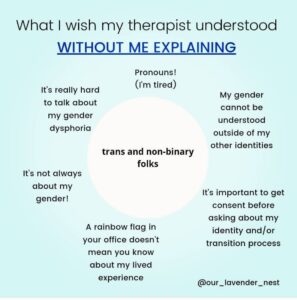 In and out of the therapy world, one of the biggest issues in supporting and advocating for gender diverse people is the fear of the unknown and potentially making a mistake, especially when it comes to understanding issues and language around these identities. The consequences of this are having clients and colleagues who feel judged, overlooked or ignored.
Fears of using the wrong terminology or pronouns, unintentionally offending someone, misgendering or misidentifying someone, and not even knowing where to start in talking about gender and identity are some of the biggest barriers to this is immensely important subject.
As a non-binary/genderqueer/trans trainee therapist, this has affected some of my closest professional and personal relationships, and I see a vast need for education, at the least on a very simple level, to help facilitate dialogue around these topics. It honestly doesn’t require that much work.
I can’t in any way speak for every gender diverse person in therapy, but many of us don’t exclusively want to talk about gender-related topics: they can be dysphoric and triggering, or feel like we’re being put in a box. And our gender identity doesn’t necessarily have anything to do with why we seek therapy – we don’t want it to be pathologised – although the grief, trauma, and other things we experience from having that identity might be pertinent to discuss if we bring them up.
When clients are gender diverse
In a world where trans young people are denied the right to transition, fully grown adults can’t even legally select their gender, and the rates of trans trauma and suicide are high, we all need to do better to help support people who identify with this, whether we’re counselling them about their gender identity or not.
You might be thinking “It’s fine. None of my clients identify outside of the binary” – but let me ask you this: How do you REALLY know that?
Most likely, it’s an assumption. And our job as therapists is making ourselves available for our clients to come to us and hopefully not feel judged, and be comfortable with us, no matter who they are or how they identify. There’s no rule that your client won’t turn around tomorrow and say they think that they’re somewhere else on the gender spectrum – so every therapist should equip themselves for the possibility. You may already have genderqueer/trans/non-binary clients and not even know – they may not see it as relevant to your work together. (And if you do, then that tells you more about yourself than them.) Are you prepared and informed on how to have conversations about gender identity if the client wants to? Are you likely to avoid those conversations, despite them potentially being in your client’s best interest, because you don’t feel that you have the language or understanding? Will you be totally dependent on the client to educate you, and what does that mean for your relationship? Have you worked on breaking down your gender assumptions and stereotypes, especially relating to LGBTQIA+ people?
Some tips for therapists:
● Know that gender and sexuality are different.
● Don’t assume gender identity based on appearances.
● Ask for pronouns before or in your first session, and share your own.
● Take great care with conversations around gender and sexualities, and understand that the client might have boundaries around these discussions – explore and reassure them.
● Don’t rely on your client to educate you about the ins and outs of gender identity.
● Understand that while there may be connections between trauma or other issues with gender, it isn’t appropriate to pathologise gender variance in your clients.
● Be curious and open.
● Be honest with yourself about the values and judgments you carry with you into your work, as there’s no doubt that it will inform the work you do – and, more importantly, how you do it.
● Be accountable and open to feedback. You will make mistakes – when you do, acknowledge them, but don’t dwell on them in front of your client.
Even if you absolutely know that you don’t have any gender divergent clients, you’ll almost certainly come across gender diverse people in your professional life.
When colleagues are gender diverse.
Something that often happens is the expectation that your trans and non-binary colleagues will educate you on various gender identities. I’m in my first year of training, and am already finding this an issue. By proactively learning, you put less pressure on them to do that. Most of us don’t mind answering questions, sense checking, or getting asked about cases – but the less energy we have to spend on the simple stuff like pronouns, language, including trans voices, or being skirted around, then the more experiential input we can relate to our colleagues and into our work.
Yes, you will make mistakes, but that’s OK. We all need to be accountable when we mess up, but that’s also the beauty of it – we understand that it happens, and, hopefully, you understanding it means it’s a learning.
How can you learn?
There are a lot of resources online, GSRD training through Pink Therapy and there is also an opportunity to learn the basics on a short COSRT course. On 19th June 2021, Professor Christina Roberts is doing a workshop to educate therapists with knowledge and skills to be more comfortable working with people who are trans and non-binary.
The goals of this are to:
● Be aware of some of the major themes encountered when working with trans and non-binary clients.
● Have a grasp of appropriate terminology, as well as that used in much of the literature.
● Have a basic knowledge of the main surgical procedures and hormonal interventions some trans and non-binary clients request. The morning will not equip you to assess people for these things.
● Be aware of the main diagnoses which pertain to trans and non-binary people.
● Be aware of the diversity of sexuality, gender, and relationship styles of trans and non-binary people.
● Be aware of the difficulty of differentiating non-trans (cisgender) and trans and non-binary experience.
REGISTER HERE
Hope to see you there.
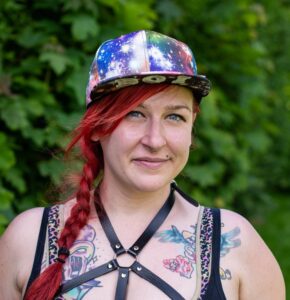 Shae Harmon (they/them) is a trainee therapist and a student member of COSRT.
They are seeing clients at The Awareness Centre and are aiming to work with gender diverse people on a low-income basis in the future. Follow Shae at https://www.instagram.com/shaequeertherapy/